
Quick answer: A trained guard can check an employee card in about ten seconds with five checks: does the face match the photo, does the card match the current design, does the security feature react when tilted or under a UV torch, is it in date, and does the chip work on the reader. A printed copy usually fails at least two of these. The company's job is to make each check possible: a reference card at the desk, a UV torch, a reader, and cards that actually carry a security feature.
The 5 checks
1. Face to photo (3 seconds)
Look at the person first, then the photo, then the person again. Compare things that do not change with a haircut or beard: the shape of the ears, the distance between the eyes, the hairline. Do not take the card and look down at it while the person walks past; hold the moment.
2. Design matches the current template (2 seconds)
Fakes are often copied from an old card, a photo on social media or a different branch. Check the logo position, the colour band, the font and where the photo sits. A guard who sees the real card every day spots a wrong layout instantly, which is why a reference card at the desk matters.
3. The security feature (2 seconds)
- Holographic overlay: tilt the card under the light. A genuine overlay shows a pattern or logo that moves; a printed imitation stays flat.
- UV print: shine a small UV torch on the card. A hidden logo or text appears on a genuine card; nothing shows on a copy.
- Ghost image or fine pattern: a small faded copy of the photo, or a fine line pattern behind it, is hard to reproduce cleanly on a home printer.
4. In date (1 second)
Expired cards are the easiest fakes of all: they are real cards that should have been returned. If your cards carry an expiry date, check it every time.
5. Chip on the reader (2 seconds)
If your cards have a proximity or MIFARE chip, ask the holder to tap it on a reader at the desk. A copy printed on plain PVC has no chip, or the wrong one, and a blocked card for a former employee is refused. This is the strongest of the five checks because it is not about looks at all.
The fakes guards actually see
- The borrowed card: a real card, someone else's face. Only check 1 catches it.
- The old card: a former employee or contractor still carrying a badge. Checks 4 and 5 catch it.
- The colour copy: a card photographed and printed on PVC. Checks 3 and 5 catch it.
- The home-made card: a design copied from a website or a colleague's photo. Check 2 usually catches it first.
What to do when a card fails
- Stay polite. Ask the person to wait and step aside.
- Call the person's manager or HR, or check the access system for the employee number.
- Keep the card if your policy allows; it is company property.
- Write a short report: time, name given, which check failed.
Most failed checks turn out to be an expired card or a new employee whose card is not ready. That is fine; the point is that the guard checked.
What guards need from the company
| Tool | Why |
|---|---|
| Reference card of each current design | For check 2 |
| Small UV torch | For check 3, if cards use UV print |
| Desktop card reader linked to the access system | For check 5 |
| A list of blocked and expired cards, or system access | For checks 4 and 5 |
| A simple escalation rule | So guards are not left to argue |
Making cards harder to fake
Every check above depends on the card having something worth checking. Practical upgrades, from cheapest to strongest:
- A clear design with an expiry date and colour codes, printed consistently. See the 10-item employee badge checklist.
- A fine background pattern and a ghost image behind the photo; any good design software can do this.
- A chip inside the card, linked to your access control. Proximity cards cost about SAR 5.69 each.
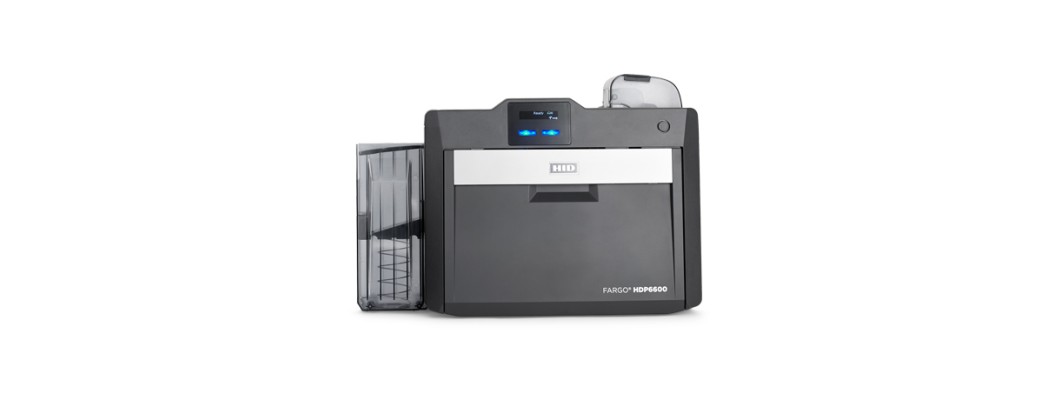
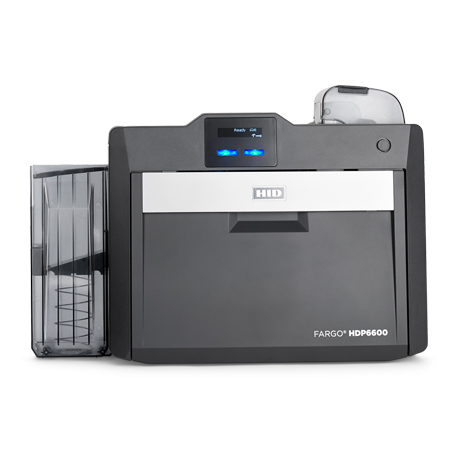
- A holographic or UV overlay. Retransfer printers apply a film over the whole card and can use secure or custom holographic films. Examples: HID Fargo HDP5000e (SAR 17,077.50), HID Fargo HDP6600 (SAR 19,354.50) and the Bravo RTAI (SAR 18,785.25).
Not every company needs level 4. A shop with ten staff is well served by levels 1 to 3. A hospital, airport supplier or government contractor should look at all four. Read when you need a high-security card printer to decide.
Train it in ten minutes
Give guards five real cards and five obvious fakes (an old design, a photocopy, an expired card, a card with no chip, a card with another person's photo) and let them practise the five checks. Repeat every few months and whenever the card design changes.
Quick questions
Should guards check managers too? Yes. A rule that applies to everyone is easier to enforce, and senior staff are the ones fakers most like to imitate.
What if we change the card design? Run old and new designs side by side for a short, announced period, put both reference cards at the desk, then block the old cards in the system on a fixed date.
Talk to us
Count Express supplies card printers, secure ribbons and films, chip cards and readers across Saudi Arabia, with sales and distribution centres in Riyadh, Jeddah and Al Khobar. Ask us on WhatsApp which security features fit your cards, or browse ID card printers.
Prices include 15% VAT and may change.
Leave a Comment