
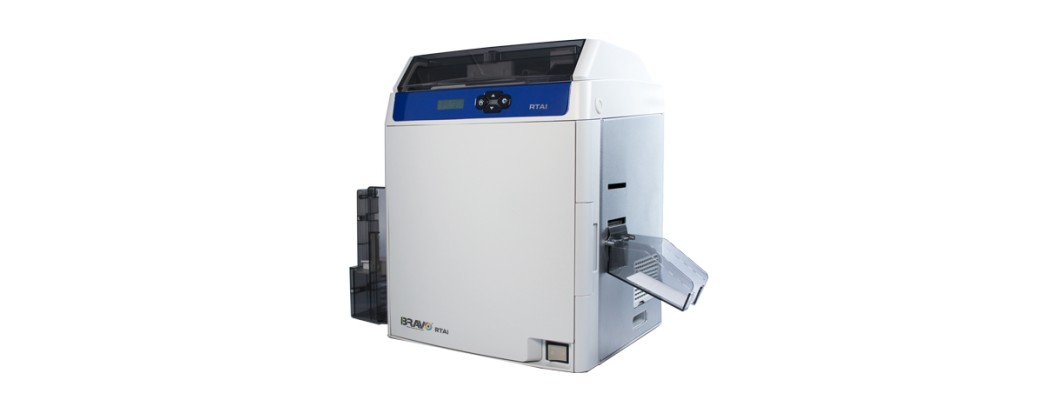
Quick answer: You need a high-security card printer when a fake or altered card would cause real harm: access to sensitive sites, cards that serve as a person's main ID, long validity, or smart cards that must also look official. In those cases a retransfer printer such as the Bravo RTAI (SAR 18,785.25) earns its price through 600 dpi detail for fine security printing, a film that shows tampering, and durable over-the-edge cards. If your cards are simple staff badges for a small team, renewed every year or two, a standard direct-to-card printer is enough, and spending more buys you little.
What "high security" means in a card printer
A printer does not make a card secure by itself. It makes certain security features possible, and makes cards harder to alter:
- Retransfer printing: the image is printed on a film and bonded to the card. Trying to peel or alter the film damages the image, so tampering shows.
- Fine detail: higher resolution, such as 600 dpi on the Bravo RTAI, allows microtext, fine guilloche patterns and sharp ghost images that are hard to copy with an ordinary printer.
- Over-the-edge printing: no white border that a forger can use as a guide.
- Secure films and overlays: holographic or UV films add a feature a guard can check in seconds.
- Printing on chip cards: retransfer prints evenly over the slight bumps of chip and contactless cards, where direct printing can leave gaps.
- Durability: a card that still looks right after years of use is easier to check and harder to pass off.
Cases that justify a high-security printer
| Situation | Why it matters |
|---|---|
| Government entities and their contractors | Cards act as official ID and open restricted areas |
| Hospitals | Access to pharmacies, theatres and patient areas; staff in many roles |
| Universities | Thousands of student cards used for access, library and payments over several years |
| Airports, ports, oil and gas sites | High-risk areas where a fake badge is a safety issue |
| Banks and cash centres | Access to vaults and cash rooms |
| Membership cards with value | Cards that grant paid access are worth forging |
For these, also read how a guard spots a fake card in 10 seconds: the printer's features only help if your guards actually check them.
When a standard printer is enough
- A small or mid-size company with staff who know each other by sight.
- Badges used mainly for identification and attendance, renewed every one to two years.
- Visitor or event cards with short validity.
- Low print volumes, where the card's look matters more than tamper resistance.
Here a direct-to-card printer with a YMCKO ribbon, plus a chip inside the card for access, gives good protection at a much lower cost. Options include the Finloyd Fin-CP (SAR 3,643.20), Evolis Zenius 2 (SAR 4,326.30) and the dual-sided Evolis Primacy 2 Duplex (SAR 7,741.80). The chip does more for door security than any print feature.
The options compared
| Printer | Type | Strength | Price incl. VAT |
|---|---|---|---|
| Finloyd Fin-CP | Direct-to-card | Budget, low volume | SAR 3,643.20 |
| Evolis Primacy 2 Duplex | Direct-to-card, dual-sided | Everyday workhorse for offices | SAR 7,741.80 |
| HID Fargo HDP5000e | Retransfer, modular | Add dual-sided, encoding and lamination as needs grow | SAR 17,077.50 |
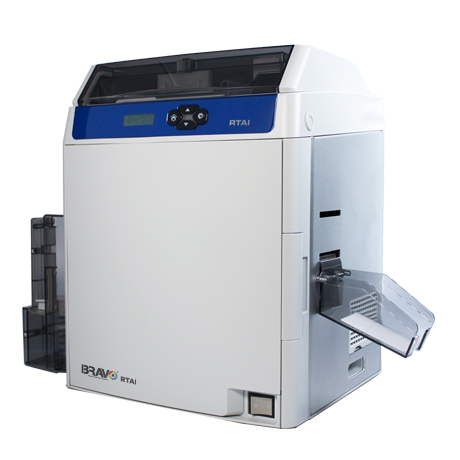
| Bravo RTAI | Retransfer, 600 dpi | Fine detail and durable cards without a laminator | SAR 18,785.25 |
| HID Fargo HDP6600 | Retransfer, high volume | Up to 230 cards an hour | SAR 19,354.50 |
Why the Bravo RTAI stands out
- 600 dpi retransfer for photo-quality cards and fine security detail.
- One or two sides, over the edge.
- 0.7 mil patch retransfer ribbon that gives longer card life without a separate laminator.
- 250-card hopper that can be topped up while printing, useful for large issuing runs.
- About 25 seconds a card single-sided and 55 seconds dual-sided.
- 3-year warranty, with setup support from Riyadh, Jeddah and Al Khobar.
Two examples
A 40-person trading company in Riyadh prints staff badges with proximity chips for the office door. A dual-sided direct-to-card printer is the right fit: badges look professional, the chip controls the door, and the budget goes further.
A private hospital in Jeddah issues badges to doctors, nurses, contractors and students, opening pharmacy and theatre areas, valid for several years. A 600 dpi retransfer printer with a secure overlay makes sense: badges are checked often, must last, and a fake badge is a patient safety risk.
Look at the cost per card, not just the printer
Retransfer printers cost more to buy and use both a ribbon and a film, so each card costs more to print. But cards last longer, so you reprint less, and a single prevented incident at a sensitive site outweighs years of consumables. Work out cost per card over the card's whole life, not per print. See card printer running cost per card.
Five questions to decide
- What would a fake card let someone do? If the answer is "walk into a sensitive area", lean high-security.
- How long are cards valid? Longer validity needs more durability.
- Do you print on chip cards? Retransfer handles them better.
- How many cards a year? Higher volumes favour faster retransfer printers.
- Will guards check visual security features? If not, put the budget into chips and readers first.
Still unsure about the printing method itself? Read retransfer vs direct-to-card printing.
Talk to us
Count Express supplies standard and high-security card printers across Saudi Arabia from sales and distribution centres in Riyadh, Jeddah and Al Khobar. Tell us who uses your cards and what they open, and we will recommend the level that fits. Message us on WhatsApp or browse ID card printers.
Prices include 15% VAT and may change.
Leave a Comment