
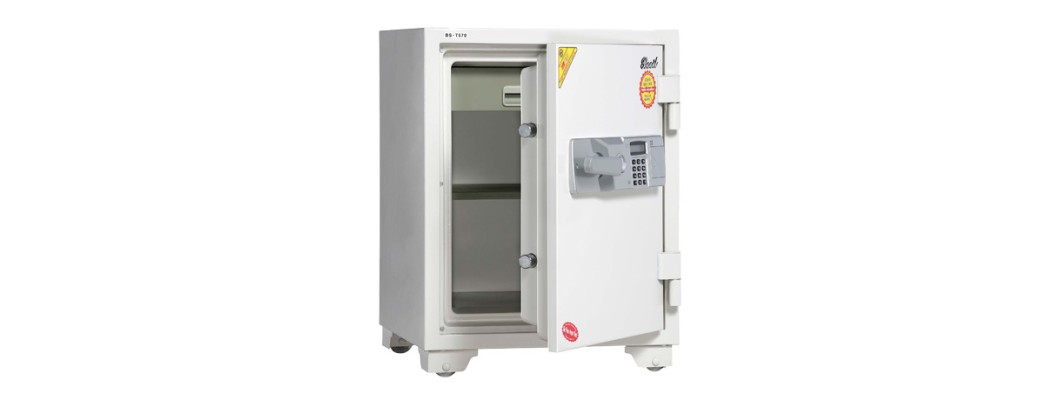
Quick answer: Do not start with a drill. First work out which lock you have. With a digital lock, most "forgotten code" calls turn out to be flat batteries, a lockout after too many wrong tries, or a manager code that still works. With a key lock, the supplier can often get a replacement key from the key number, once you prove the safe is yours. Only when those fail should a technician open the safe, and on a certified safe that should be done by someone the manufacturer approves, so the grade can be restored.
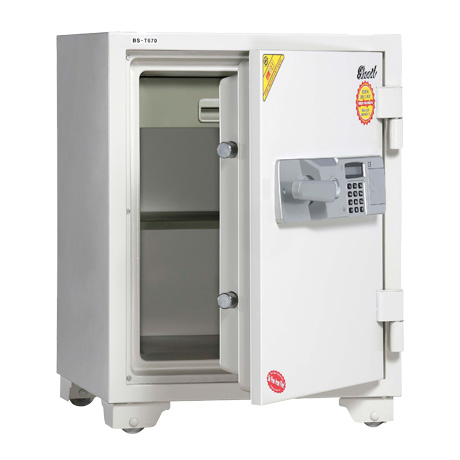
Step 1: Identify your lock
| Lock type | How it looks | Common on |
|---|---|---|
| Digital / electronic (EL) | Keypad, sometimes with a display | Home and office safes, hotel safes |
| Key (KL) | Keyhole, usually a double-bit key | Fire safes, deposit safes, older safes |
| Dual: key + key (KK) | Two keyholes; both keys needed | Business safes needing two people |
| Dual: key + electronic (KL+EL) | Keypad and keyhole; both needed | Graded business safes |
With a dual lock, both parts must work. A lost key on a key + code safe is still a lost key, even if you know the code.
Step 2: If you forgot a digital code
- Check the batteries. A dim display, no beep, or a slow motor usually means flat batteries. Many safes have batteries in the keypad on the outside, or terminals for an external battery. Replace them and try the code again.
- Wait out a lockout. After several wrong codes, most electronic locks block entry for a few minutes, and longer after repeated wrong tries. Keying more codes during the lockout can restart it. Wait the full time, then try calmly.
- Try the manager or master code. Business safes often have a manager code that can open the lock or reset user codes. Check who in the company holds it.
- Look for an emergency override key. Many home safes with a digital lock come with an override key, usually hidden behind a cover near the keypad. If you have it, use it.
- Do not try a factory reset with the door locked. On most safes, the reset button is inside the door and only works when it is open.
Step 3: If you lost the key
- Find the key number. It is often stamped on the key itself, on a tag supplied with the keys, or on the paperwork. Spare keys are cut from this number by the manufacturer, not by a high-street key cutter.
- Find proof of ownership: the invoice, delivery note or company records, plus ID. A responsible supplier will not order a key without it.
- Contact the supplier, giving the safe model, serial number and key number.
- If it is a business safe, treat the lost key as a security risk: once the safe is open, change the lock or have it re-keyed, because someone may have the old key.
Step 4: If nothing works
A trained safe technician can usually open a safe without destroying it, by manipulating the lock or by a planned drill point that can be repaired. On a certified safe, the opening and the repair should follow the manufacturer's method, otherwise the burglary grade may no longer apply. That matters if your insurance names a grade: see how to check a safe's certificate.
Expect the technician to ask for proof of ownership before starting. That protects you as much as anyone.
Hotel room safes
Guests forgetting their code is a daily event in hotels. Room safes are designed for it: duty managers use a master code or an override key, and many models keep an audit trail of openings. Keep the override key with the duty manager, not at reception, and record every emergency opening with the room number, time and staff name. If guests often lock themselves out, check the batteries first: weak batteries cause most hotel safe calls.
What not to do
- Try to pry the door or hammer the handle. You can jam the boltwork and turn a simple opening into a major repair.
- Call someone who will open any safe without asking whose it is.
- Drill a certified safe yourself.
- Keep entering random codes during a lockout.
Choosing a lock so this happens less
| Lock | Good for | Main risk | Example |
|---|---|---|---|
| Two keys | Simple, no batteries | Lost keys | Countexpress Safe 105K, SAR 1,821.60 |
| Key + digital | Home use with a backup | Forgotten code, flat batteries | Countexpress Safe 105T, SAR 2,108.50 |
| Key + key (dual control) | Two-person control in a business | One keyholder away | Valberg FRS 51 KL+KL, SAR 1,484.60 |
| Key + electronic | Business safes with audit and codes | Needs both parts working | Valberg FRS 51 EL+KL, SAR 1,682.70 |
Prevention checklist
- Write down the key number and safe serial number and keep them away from the safe.
- Store the spare key in a different building, such as a bank box or a second branch.
- Change keypad batteries once a year, before they warn you.
- Give each person their own code where the lock allows, and delete codes when staff leave.
- Keep the invoice. It is your proof of ownership on the day you need it.
Need help now?
Count Express supplies and supports safes across Saudi Arabia from sales and distribution centres in Riyadh, Jeddah and Al Khobar. Send us the safe model, a photo of the lock and your proof of ownership, and we will tell you the next step. Message us on WhatsApp or browse safes.
Steps vary by lock make and model; always follow the lock manual. Prices include 15% VAT and may change.
Leave a Comment