

Quick answer: A genuinely certified safe carries a metal plate, usually riveted inside the door, that names the standard (for example EN 1143-1), the grade, the certification body, a certificate number and the safe's own serial number. To check it is real: read the plate, match the serial number to the safe and the invoice, ask the seller for the full certificate, and confirm the certificate with the body that issued it, using its online register where one exists. If any of those steps fails, treat the grade as unproven.
Why this matters
A burglary grade is only worth something if an independent lab tested that model and a certification body keeps watching production. Insurers rely on that. Unfortunately, "Grade III" written in a brochure costs nothing, and some safes on the market carry claims that were never certified, or certificates that belong to a different model. Five minutes of checking protects both your valuables and any insurance claim. Our guide on home safes and insurance in Saudi Arabia explains why insurers ask for proof.
Step 1: Find the plate
Open the door and look on the inside edge or the inner face of the door. A certification plate is normally a small metal plate, riveted or permanently fixed. A paper sticker is not a certification plate.
Step 2: Read what it says
| On the plate | What it means | What to check |
|---|---|---|
| Standard, e.g. EN 1143-1 | The test the safe passed | Burglary: EN 1143-1 (safes), EN 14450 (lighter cabinets, S1/S2). Fire: EN 15659 (LFS 30P/60P), EN 1047-1 |
| Grade or class | The level achieved | Matches what you were sold, e.g. Grade I, II, III |
| Certification body mark | Who certified it | A named body such as ECB·S, VdS or A2P, not just "tested" |
| Certificate number | The record you can verify | Same number as on the paper certificate |
| Manufacturer and model | Which product was tested | Same model as your invoice |
| Serial number and year | This individual safe | Matches the serial elsewhere on the safe and the invoice |
Step 3: Match the serial number
The serial number on the plate should match the number on the invoice, the delivery note and, where there is one, a second serial mark on the body. A plate with no serial number, or one that does not match, is a warning sign.
Step 4: Ask for the full certificate
A reputable supplier can send you the certificate for the model: a document from the certification body naming the manufacturer, the model range, the standard and grade, and the dates. Check that your model is listed, and that the certificate was valid when your safe was made.
Step 5: Confirm with the certification body
This is the step most buyers skip. Certification bodies keep records of what they have certified. VdS in Germany, for example, publishes an online database so anyone can check an approval, and other bodies will confirm a certificate number if you contact them. If the body named on the plate has never heard of the certificate number, you have your answer.
Red flags
- "Tested to" instead of "certified to". A manufacturer can test its own product to a standard; certification means an independent body confirmed it and keeps checking production.
- A grade with no standard, such as "Grade 3 safe" with no EN number.
- A fire rating presented as security. LFS 60P is a fire rating; it says nothing about burglary.
- A sticker instead of a plate, or a plate that looks newer than the safe.
- A certificate for a different model or a different manufacturer.
- The lock is not mentioned. Graded safes use certified locks, usually to EN 1300. Swapping the lock for an uncertified one can affect the grade.
Fire and burglary are separate certificates
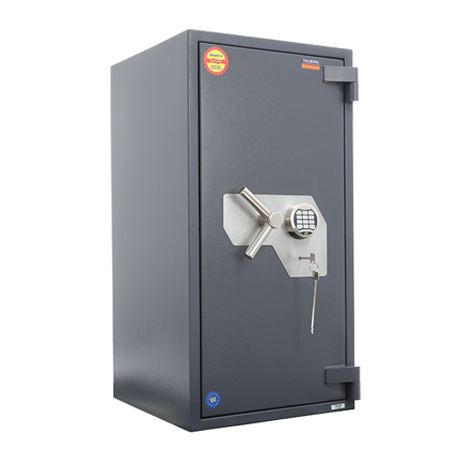
Many safes carry both: a burglary grade and a fire rating. They are different tests, often by different labs, and should appear as separate lines on the plate or as separate certificates. For example, the Valberg Granit 65 is listed as Grade I with LFS 30P, the Bastion M 1068 as Grade II with LFS 30P, and the FORT M 1068 as Grade III with LFS 30P. Each of those should show two ratings. Read more in fire safe vs burglary safe.
Checking a safe you already own
- Photograph the plate and the serial number.
- Find the original invoice or ask the supplier for a copy.
- Ask the supplier or manufacturer for the certificate for your model and year.
- Verify the certificate number with the body named on the plate.
- Keep all of it with your insurance documents.
If the safe turns out not to be certified, it still has value as a deterrent and, if fire-rated, as a fire safe. But do not rely on it for an insurance condition that names a grade.
Quick questions
The plate is missing on a second-hand safe. Can it be replaced? Only the manufacturer can issue a replacement plate, usually after checking the serial number. A plate added by anyone else proves nothing.
Does the grade last forever? The test result does, but damage, drilling or lock changes can affect it. If a safe has been forced open or repaired, ask the manufacturer whether the grade still applies.
Certified safes from Count Express
| Grade | Example | Price incl. VAT |
|---|---|---|
| EN 1143-1 Grade I | Valberg Granit 65 | SAR 5,840.51 |
| EN 1143-1 Grade II | Valberg Bastion M 1068 | SAR 13,775.85 |
| EN 1143-1 Grade III | Valberg FORT M 1068 | SAR 20,493.00 |
For any safe we supply, we can send the certificate for the model before you buy. Count Express has sales and distribution centres in Riyadh, Jeddah and Al Khobar and delivers across Saudi Arabia. Ask for a certificate on WhatsApp or browse certified safes.
Prices include 15% VAT and may change.
Leave a Comment