
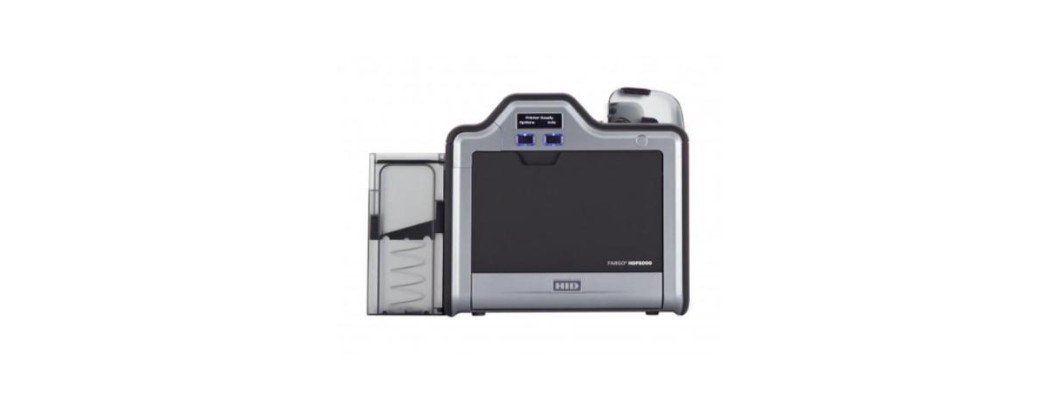
Quick answer: Chip smart cards, both contact cards with a gold chip and contactless cards with an antenna inside, are not perfectly flat. Direct-to-card printers press the printhead straight onto the card, so over a chip or antenna they often leave white gaps, faint patches or streaks, and a hard contact chip can even damage the printhead. Retransfer printers print onto a clear film first and then heat-bond the film to the card, so the image follows the surface evenly and covers the edges. If most of your cards carry a chip and appearance matters, retransfer is the reliable choice.
What makes chip cards hard to print
- Contact chips (the gold pad on bank-style cards) sit slightly raised or recessed. A direct-to-card printhead cannot print on the metal and must avoid it.
- Contactless cards (proximity, MIFARE, DESFire) have an antenna and a chip module laminated inside. The surface above them often has tiny bumps or dips.
- Dual-interface cards have both.
A direct-to-card printhead needs firm, even contact. Where the surface is uneven, the dye does not transfer fully. The result is a white spot or a lighter patch, often right across the photo or the name.
How the two methods compare
| Point | Direct-to-card | Retransfer |
|---|---|---|
| How it prints | Printhead prints directly on the card | Prints on film, film bonded to card |
| On uneven chip cards | Gaps and faint areas likely | Even image over bumps |
| Edge of card | Small white border | True over-the-edge |
| Durability | Thin overlay | Film protects the image |
| Tamper evidence | Limited | Film shows attempts to alter |
| Cost per card | Lower | Higher (ribbon plus film) |
| Printhead wear on chip cards | Higher | Lower: the head touches the film, not the card |
When direct-to-card is still fine
- Proximity cards with a flat surface where the design leaves the chip area clear or uses a plain colour there. Many offices print acceptable badges this way.
- Low volumes where an occasional imperfect card can simply be reprinted.
- Printing the chip card's design only on the side away from the chip for contact chip cards.
In these cases a good direct-to-card printer such as the Evolis Primacy 2 Duplex (SAR 7,741.80) works, but test with your actual cards first.
When you need retransfer
- Full-photo or full-colour designs across the whole card.
- Universities, hospitals and government bodies issuing thousands of chip cards a year.
- Cards that must look official and resist tampering for several years.
- Contact chip or dual-interface cards with designs that run over the chip area.
Retransfer printers we supply
| Printer | Best for | Price incl. VAT |
|---|---|---|
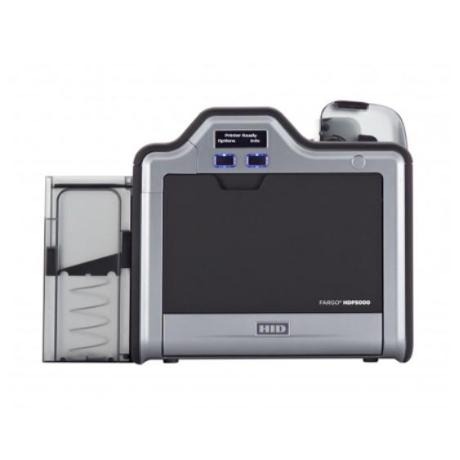
| HID Fargo HDP5000e | Modular: add dual-sided, smart card encoding and lamination | SAR 17,077.50 |
| Bravo RTAI | 600 dpi detail, durable cards without a laminator | SAR 18,785.25 |
| HID Fargo HDP6600 | High volume, up to 230 cards an hour | SAR 19,354.50 |
| Evolis Agilia | Evolis retransfer for high-quality cards | SAR 21,062.25 |
| Evolis Avansia | Evolis retransfer for demanding programmes | SAR 22,200.75 |
For supply details on the Fargo models see HID Fargo ribbons and films, and to decide on the level of security, when you need a high-security card printer.
Printing and encoding in one pass
Many retransfer printers can also encode the chip while printing, writing the card number or credentials into it, if fitted with the right encoder. That saves a second step at an encoding station and makes sure each printed name matches the chip inside. Check which card technology you use (125 kHz proximity, MIFARE Classic, DESFire and so on) before ordering an encoder.
Tips for better results on chip cards
- Order cards from a reliable supplier; surface quality varies a lot between batches.
- Keep cards in their wrapping until use; dust shows more on retransfer film.
- Avoid placing the photo directly over a contact chip.
- Run a test batch of 10 cards from every new box before a big issuing day.
- Clean the printer at every ribbon and film change.
Example: a university in the Eastern Province
A university switched its student cards to MIFARE chip cards for gates, library and canteen. Its existing direct-to-card printers left faint patches across many photos, and staff were reprinting a noticeable share of each batch. Moving the main issuing office to a retransfer printer with an encoder solved both problems: the photos printed evenly, and each card was encoded as it was printed, so the name on the front always matched the chip.
Quick questions
Can I tell from the card whether it has a chip? Contact chips are visible. Contactless chips are usually not; hold the card up to a strong light and you may see the antenna, or test it on a reader.
Does printing damage the chip? Not when done correctly. Retransfer bonds the film with heat, within the limits card makers design for.
Cost: is retransfer worth it?
Retransfer costs more per card because it uses a ribbon and a film. But chip cards themselves are more expensive than plain PVC, so every spoiled card costs more too. Fewer reprints, longer card life and less printhead wear often close most of the gap. Our running cost per card guide helps you compare.
Ask us
Count Express supplies retransfer and direct-to-card printers, chip cards such as proximity cards (SAR 5.69 each) and supplies across Saudi Arabia from sales and distribution centres in Riyadh, Jeddah and Al Khobar. Send us a sample of your chip card, and we will print a test. Message us on WhatsApp or browse ID card printers.
Prices include 15% VAT and may change.
Leave a Comment