
Quick answer: A good employee badge for a Saudi company carries ten things: the company logo and name in Arabic and English, a recent photo, the employee's name in both languages, an employee number, the department or a colour code, an issue and expiry date, a machine-readable element (barcode, QR or chip) for access and attendance, a "return if found" line on the back, and at least one feature that is hard to copy. Leave off national ID or Iqama numbers and anything else that would help a thief if the card is lost.
The 10-item checklist
Front of the card
- Company logo and name, Arabic and English. Visitors, contractors and government inspectors should recognise your company at a glance. Keep the logo in the top band where a badge holder will not cover it.
- A recent photo. Plain light background, head and shoulders, no sunglasses. The photo is the first check a guard makes, so make it large: at least a third of the card height.
- Full name in Arabic and English. Use the spelling on the employee's official documents so it matches when HR or security compares them.
- Employee number. Short and unique. It links the card to HR and attendance records without exposing personal data.
- Department or a colour code. A coloured band (for example blue for office staff, orange for warehouse, red for restricted areas) lets a guard see from a distance whether someone belongs in an area.
- Issue and expiry date. An expiry date forces regular renewal and makes old cards easy to spot. Gregorian, Hijri or both, as your HR system uses.
Back of the card
- A machine-readable element. A barcode or QR code for basic systems, or a chip (proximity or MIFARE) inside the card for access control and attendance. A chip card cannot be photocopied the way a barcode can.
- "If found, please return to" with the company address and phone number. Nothing more personal.
- Short rules, such as "This card remains company property. Report loss immediately to security."
- A security feature. A holographic or UV-printed overlay, a printed pattern behind the photo, or a ghost image of the photo. See how a guard spots a fake card in 10 seconds.
What to leave off
- National ID or Iqama numbers. A lost badge should not hand someone an identity document number.
- Personal phone numbers, home addresses, blood group or medical details, unless a specific safety rule requires them and staff have agreed.
- Job titles for sensitive roles such as cashier or IT administrator, if that makes the holder a target. A colour code can do the job instead.
- Door codes or passwords. It happens more than you would think.
Layout tips for bilingual cards
- Put Arabic on the right and English on the left at the same height, or Arabic above English. Do not squeeze both into one line.
- Choose fonts that print cleanly at small sizes. Thin Arabic fonts can break up on a direct-to-card printer.
- Keep text away from the card edges and from where a slot punch or chip sits.
- Test print one card and read it at arm's length before printing the whole batch.
Common design mistakes
- A tiny photo with a busy background that a guard cannot match to a face.
- The logo printed where the holder clip or lanyard hole covers it.
- Dark text on a dark colour band that disappears under reception lighting.
- Every department in a slightly different blue, so the colour code means nothing.
- No expiry date, so cards from staff who left years ago still look valid.
Card, printer and software
| Item | What to choose | Example | Price incl. VAT |
|---|---|---|---|
| Card | Standard CR80 PVC; chip card if used for doors | White PVC cards (250), proximity cards | SAR 113.85; SAR 5.69 each |
| Printer, one side | Front only, back printed rarely | Evolis Zenius 2 | SAR 4,326.30 |
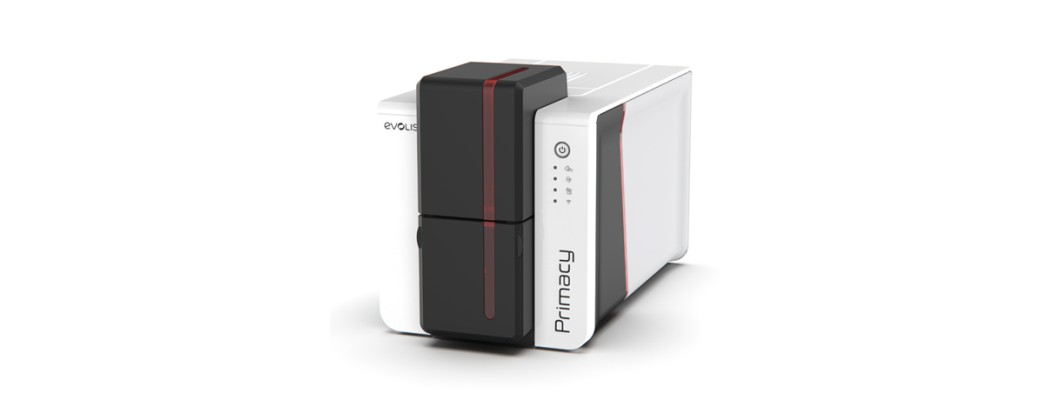
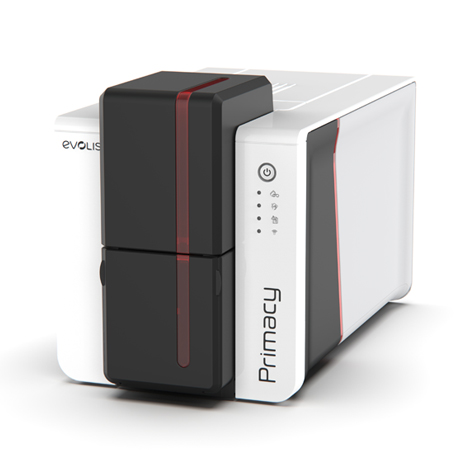
| Printer, both sides | Front and back in one pass | Evolis Primacy 2 Duplex | SAR 7,741.80 |
| Budget printer | Small batches | Finloyd Fin-CP | SAR 3,643.20 |
| Design software | Templates, photos, barcodes, database link | cardPresso | SAR 512.33 |
| Wearing | Holder and reel or lanyard | clear card holder, badge reel | SAR 3.42; SAR 4.55 |
Most of the ten items sit on the back, so a dual-sided printer saves a lot of handling once you print more than a few cards a week. For the setup steps, read setting up in-house badge printing.
Visitor and contractor cards
Use a different design for anyone who is not staff, so the difference is obvious from across a room. A bold "VISITOR" or "CONTRACTOR" band in a colour no employee card uses, a large number instead of a photo, and the date or a validity window. Collect them at the exit. Our guide on visitor badges at reception covers the routine.
When to reprint
- At the expiry date printed on the card.
- When someone changes department or access level.
- When the photo no longer looks like the person.
- When a card is lost, and the old one is blocked in the system first. See what to do in the first hour after a card is lost.
A template you can copy
| Area | Front | Back |
|---|---|---|
| Top band | Logo and company name (AR/EN), department colour | Company address and phone |
| Middle | Photo; name in Arabic and English | Barcode or QR; chip inside the card |
| Bottom | Employee number; expiry date | Return line; short rules; security overlay |
Ready to design yours?
Count Express supplies card printers, cards, software and accessories across Saudi Arabia from sales and distribution centres in Riyadh, Jeddah and Al Khobar. Send us your logo and current badge, and we will suggest a layout and the printer that fits your volume. Message us on WhatsApp or browse ID card printers.
Prices include 15% VAT and may change.
Leave a Comment