
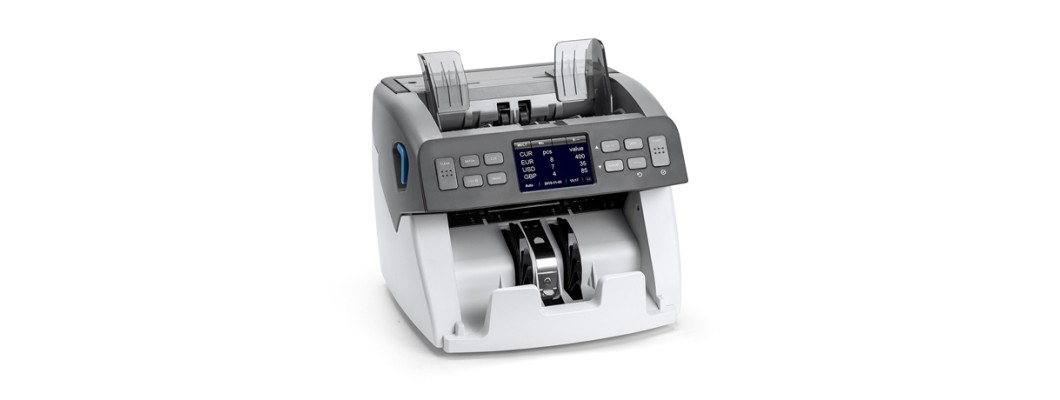
Quick answer: Do not buy a money counter on its brochure. Take your own notes to the showroom and run six tests: the same mixed bundle three times, worn and new notes, a non-banknote and a foreign note, stuck and half notes, notes loaded every which way (this is where dual CIS shows its value), and a timed 1,000-note run. A good machine passes all six in about fifteen minutes. This guide tells you what to bring, how to run each test and what a pass looks like.
What to bring
- A mixed bundle with a known total, for example exactly SAR 10,000 in 500, 100, 50, 10 and 5 riyal notes. Count it carefully at the shop beforehand and write the breakdown down.
- Some worn notes: limp, creased, written on, slightly torn at the edge.
- Both kinds of 5-riyal note, paper and polymer, if you have them.
- One foreign note (dirhams, dollars) and a plain paper slip cut to note size.
- A phone with a stopwatch.
Never bring or make copies of banknotes to "test" detection. Ask the showroom to demonstrate counterfeit detection with their own test material instead.
The six tests
Test 1: The same bundle, three times
Put the machine in mixed or value mode and count your known bundle three times without changing anything. Pass: the riyal total and the breakdown by denomination match your written figures every time. Fail: any difference at all. A counter that is out by one note in a showroom will be out by more after six months of dust.
Test 2: Worn and new notes together
Mix your worn notes into the bundle with some crisp new ones and count again. Old and new notes behave differently in the feed: new ones stick together, old ones fold. Pass: correct total, with only a few rejects that pass on the second run. Fail: frequent stops or double-feeds.
Test 3: A foreign note and a paper slip
Slip the foreign note and the paper slip into the middle of the bundle. Pass: the machine stops or sends both to the reject pocket and tells you why. Fail: either one is counted as a riyal note.
Test 4: Stuck notes and half notes
Put two notes together, slightly offset, and include a note folded in half. This checks double-note and half-note detection, which catch the most common counting errors in daily use. Pass: both are flagged. Fail: the count simply carries on.
Test 5: Load the notes every which way (the CIS test)
Turn some notes upside down, some back to front and some the other way round, then count. This is where the sensor design shows. A dual CIS machine has contact image sensors that scan both sides of every note, so it can read the denomination and check features whichever way the note faces. Machines with simpler sensors may need the notes faced and oriented first, which takes time every single day. Pass: correct total and breakdown with notes in any orientation. Fail: errors or many rejects until you face the notes.
If you need serial numbers recorded, for example for large customer payments, ask the showroom to show you where they appear and how they are exported. The Fin-7900 (SAR 6,489.45) is an example of a mixed value counter that reads serial numbers; our guide to serial number recording explains when you need it.
Test 6: A timed 1,000-note run
Count about 1,000 notes and time the whole job, from picking up the stack to writing the total, not just the motor's speed. Watch how it handles rejects: does it stop every time, or send them to a separate pocket and carry on? Pass: a smooth run with rejects you can deal with at the end. Two-pocket machines such as the Kisan K2 (SAR 6,603.30) keep running while rejects collect separately, which matters at high volumes.
A short note on sensors
Brochures list sensor names that sound alike. In practice: UV checks how the paper reacts to ultraviolet light, MG checks magnetic ink, IR checks infrared features, and CIS takes an image of the note. Single CIS images one side; dual CIS images both. More sensors are not automatically better: what matters is whether the machine passes tests 1 to 5 with your own notes.
Score sheet
| Test | What it checks | Pass? |
|---|---|---|
| 1. Same bundle three times | Repeatability | Yes / No |
| 2. Worn and new notes | Feeding | Yes / No |
| 3. Foreign note and paper slip | Denomination and currency recognition | Yes / No |
| 4. Stuck and half notes | Double and half-note detection | Yes / No |
| 5. Any orientation | Image sensors (dual CIS) | Yes / No |
| 6. Timed 1,000 notes | Real speed and reject handling | Time: ___ |
Questions to ask before you pay
- Who updates the software when SAMA issues a new note, and how long does it take?
- Is there service in your city, or does the machine have to be shipped?
- What is the warranty and what does it cover (rollers, sensors, motor)?
- Are cleaning tools and spare rollers available locally?
Which machines to test
| Your situation | Machine to try | Price incl. VAT |
|---|---|---|
| Mostly sorted notes, small volume | Fin-890 | SAR 910.80 |
| Mixed riyals | CountExpress CX-7500 | SAR 4,554.00 |
| Mixed riyals, value counting | Fin-7000 | SAR 5,578.65 |
| Mixed with serial numbers | Fin-7900 | SAR 6,489.45 |
| High volume, two pockets | Kisan K2 | SAR 6,603.30 |
Before you go, read 7 mistakes when buying a money counter and money counter features explained.
Test them with us
Count Express has sales and distribution centres in Riyadh, Jeddah and Al Khobar. Bring your own bundle and run all six tests before you decide. Book a time on WhatsApp or browse all money counting machines.
Prices include 15% VAT and may change.
Leave a Comment