
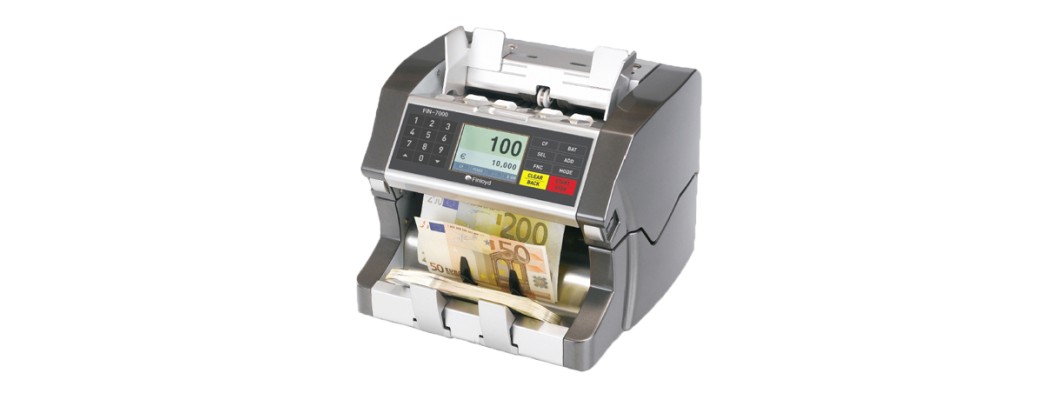
Quick answer: With a value counter set to mixed mode, a typical shop day of up to about 1,500 mixed riyal notes can be counted, checked and recorded in under five minutes. The trick is not the machine's speed but a fixed routine: take out the float and coins, count in batches, deal with rejects once at the end, then record the breakdown by denomination. Here is the routine, minute by minute.
What you need before you start
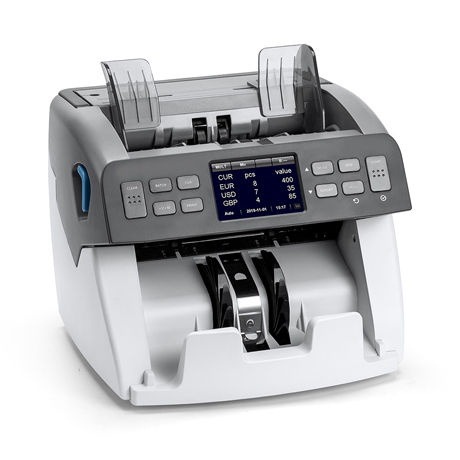
- A value counter, not a sheet counter. A sheet counter only tells you how many notes there are; a value counter reads each denomination and adds up the riyals. Examples: CountExpress CX-7500 (SAR 4,554.00), Fin-7000 (SAR 5,578.65) or, for SAR, USD and EUR, the Fin-7300 (SAR 6,261.75).
- Your POS end-of-day report, so you can compare straight away.
- A cash-up sheet with a line for each denomination: 500, 200, 100, 50, 20, 10, 5 and 1 riyal.
- Deposit bags or a drop safe, so counted cash does not sit on the counter.
The 5-minute routine
Minute 0 to 1: separate what the machine should not count
- Take out tomorrow's float first and put it aside in its own bag. Counting it with the takings is the most common reason the total looks wrong.
- Remove coins, vouchers, receipts and card slips.
- Pull out notes that are torn, taped or heavily folded. They cause jams and rejects; count them by hand at the end.
- Knock the stack on the counter so the edges line up. You do not need to face the notes or sort them: a value counter with image sensors reads them either way.
Minute 1 to 3: count in batches
- Switch to MIX (or VALUE) mode and clear the previous total.
- Load a batch no bigger than the hopper comfortably holds. Overfilling causes double-feeds.
- Let the machine run. Do not add notes while it is feeding; wait for it to stop, then load the next batch. Most value counters keep a running total across batches in add mode.
- Empty the stacker after each batch so it never overflows.
Minute 3 to 4: deal with rejects once
The machine will stop or send some notes to the reject pocket: suspect notes, notes it could not read, or notes from another currency. Do not stop the whole count to investigate each one. Put rejects in one pile and, once the main count is done:
- Run the reject pile through once more. Many are simply creased and will pass.
- Check the rest by hand: watermark, security thread, raised print. If a note looks fake, set it aside and record it; do not give it back into circulation.
- Add the good rejects to the total with the add function or by hand.
Minute 4 to 5: record and close
- Press the breakdown or detail key to show how many notes of each denomination were counted, and copy it onto the cash-up sheet.
- Compare the riyal total with the POS cash figure. If the gap is small, check refunds and paid-outs before recounting.
- Bag the cash, write the total and date on the bag, and put it straight into the safe.
Why the breakdown matters
A single riyal total tells you whether the drawer balances. The breakdown by denomination tells you why it does not. If the total is 500 riyals short and there is one 500 note fewer than yesterday's pattern, you know where to look. It also makes bank deposits faster, because the deposit slip asks for the same breakdown.
Common slowdowns and how to avoid them
| Slowdown | Cause | Fix |
|---|---|---|
| Machine stops every few notes | Folded corners, notes stuck together | Fan the stack and knock it straight before loading |
| Total is far too high | Float counted with takings | Always take the float out first |
| Many notes rejected | Dusty sensors | Brush the sensors weekly; see our maintenance schedule |
| Foreign notes in the drawer | Tourist areas, exchange customers | Use a multi-currency counter such as the Fin-7000 SR-USD-EURO |
| Recount argument at shift change | No written record | Print or copy the breakdown and have both staff sign |
How many notes can you count in five minutes?
A value counter in mixed mode runs at several hundred notes a minute. Once you add loading, rejects and writing things down, plan on roughly 300 to 400 notes a minute overall. That covers most cafés, grocery shops, pharmacies and restaurants in one sitting. A supermarket or exchange office handling several thousand mixed notes a day will want a two-pocket machine such as the Kisan K2 (SAR 6,603.30) or the Kisan Newton-A (SAR 7,400.25), which send rejects to a separate pocket without stopping.
Want to know how much time your shop spends on counting today? Use our counting time table. If the drawer keeps coming up short, read 7 causes of cash shortages at the end of a shift.
Points specific to Saudi riyals
- Paper and polymer 5-riyal notes: SAMA put a polymer 5-riyal note into circulation in October 2020, alongside the paper one. Both are legal tender, so your machine must recognise both; check this when you test it.
- Rare denominations: 1, 20 and 200 riyal notes turn up less often. If your counter rejects them, ask for a software update rather than counting them by hand every night.
- Old series notes: older series still appear now and then. Keep them aside for the bank if the machine will not read them.
Our guide to counting new riyal notes explains updates in more detail.
See it counting your own notes
Count Express has sales and distribution centres in Riyadh, Jeddah and Al Khobar and delivers across Saudi Arabia. Bring a bundle of your own mixed takings and we will run it through a value counter in front of you. Book a demo on WhatsApp or see all money counting machines.
Prices include 15% VAT and may change.
Leave a Comment