
Quick answer: Multiply the number of banknotes your shop handles in a day by how long each note takes to count by hand (including the second count), then multiply by your working days. A shop taking 1,000 notes a day spends about 14 staff hours a month counting by hand; with a money counter the same work takes around 2 hours. The table below lets you read off your own figure in under a minute.
Why most owners underestimate counting time
Counting cash rarely shows up on a timesheet. It happens in small pieces: the opening float, a mid-shift pickup, the end-of-shift count, the recount when the drawer is short, and the final count before the bank deposit. Each piece feels like five minutes, so nobody adds them up. When you do add them up, counting is often the single biggest non-selling task at the till, and it usually lands at the busiest moments: shift change and closing time.
There is also a hidden multiplier. Most shops in Saudi Arabia ask for a second count by another person, or a recount when the figure does not match the POS report. That doubles the time on every bundle that gets checked.
The formula
You only need three numbers:
- Notes per day: look at a typical day's takings and estimate how many banknotes that is. A rough way: divide the cash total by your average note value (for many grocery shops and cafés it sits between 20 and 50 riyals).
- Counting speed: a careful cashier counting by hand, facing the notes, checking for fakes and recounting, manages around 30 notes a minute overall. With a machine, once you include loading, batching and writing the figure down, a realistic overall speed is about 200 notes a minute, even though the machine itself runs much faster.
- Working days: most Saudi shops open 26 to 30 days a month. The table uses 26.
Monthly hours = notes per day ÷ notes per minute × working days ÷ 60
Ready table: counting hours per month
| Notes per day | Typical business | By hand (hours/month) | With a machine (hours/month) | Hours saved |
|---|---|---|---|---|
| 300 | Small pharmacy, barber, laundry | 4.3 | 0.7 | 3.6 |
| 1,000 | Café, mini-market, mobile shop | 14.4 | 2.2 | 12.2 |
| 3,000 | Restaurant, busy grocery, fuel station | 43.3 | 6.5 | 36.8 |
| 8,000 | Supermarket, exchange office, car showroom | 115.6 | 17.3 | 98.3 |
Hand counting at 30 notes a minute, machine handling at 200 notes a minute, 26 working days. Change the speeds if your team is faster or slower; the gap stays large.
Turn hours into riyals
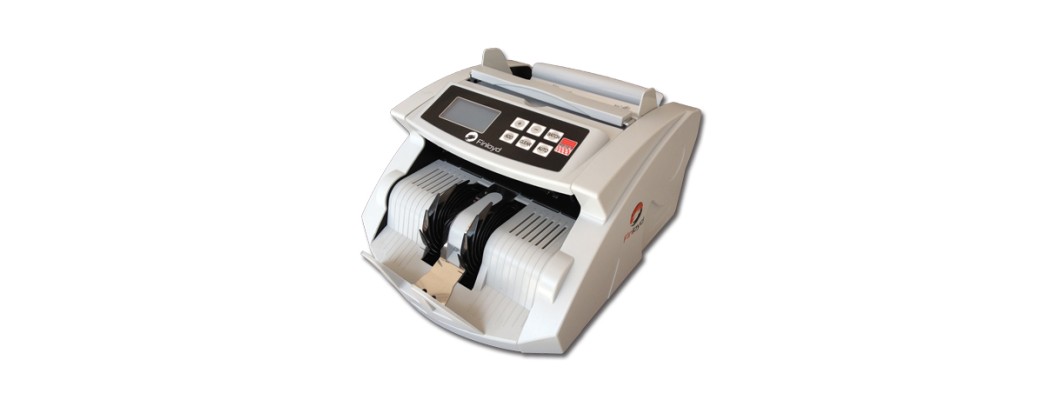
Multiply the hours saved by what an hour of your cashier's or supervisor's time costs you, including housing, transport and other allowances. If that hour costs SAR 25, a shop handling 3,000 notes a day spends roughly 37 hours, or about SAR 920 a month, on counting that a machine could take over. At that volume an entry machine such as the Fin-890 (SAR 910.80 incl. VAT) pays for itself in about a month.
The bigger saving is often not wages at all. It is:
- Shorter closing: staff leave on time, and the shop can close the drawer before the last customer has left.
- Fewer recounts: a machine gives the same total twice, so the "count it again" argument at shift change disappears.
- Fake note checks on every note: UV and MG detection checks each note as it counts, which nobody does by hand under time pressure.
- Less cash on the counter: faster counting means the takings spend less time in the open before going into the safe.
The sorting trap: mixed takings
The table assumes notes are already sorted by value. Most tills are not. If your drawer holds a mix of 5, 10, 50, 100 and 500 riyal notes, a basic counter only tells you how many notes there are, so someone still has to sort them by hand first. That sorting can take as long as the count itself.
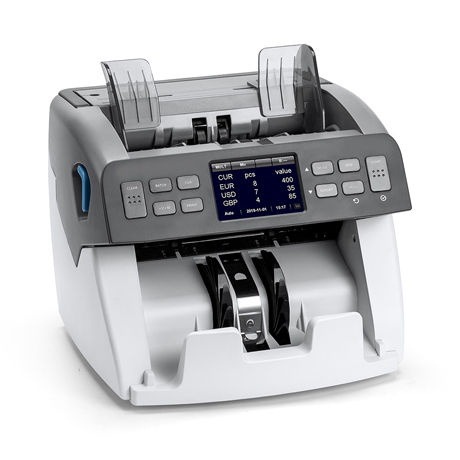
If your takings are mixed, look at a value counter instead. It reads each denomination and gives you the riyal total in one pass. The CountExpress CX-7500 (SAR 4,554.00) and the two-pocket Kisan K2 (SAR 6,603.30) are built for this. Our guide to counting mixed riyal takings in under 5 minutes walks through the routine.
Which machine fits your number?
| Your daily notes | What to look at | Example |
|---|---|---|
| Under 1,000, mostly sorted | Entry counter with UV/MG | Fin-890, SAR 910.80 |
| 1,000 to 5,000, single bundles | Heavy-duty counter for long runs | Fin-3100, SAR 3,301.65 |
| Any volume, mixed denominations | Value counter (counts the riyal total) | CX-7500, SAR 4,554.00 |
| High volume, mixed, with rejects | Two-pocket value counter | Kisan K2, SAR 6,603.30 |
For a fuller walk-through by volume, see choosing a money counter by daily cash volume, and for running costs over five years, the total cost of owning a money counter.
How to measure your own speed in one shift
- Pick a normal day, not the end of the month or a holiday weekend.
- Write down the start and end time of every count: opening float, pickups, end of shift, recounts.
- Note how many notes were in each count (or the total and main denominations).
- Divide total notes by total minutes. That is your real hand-counting speed.
- Put your own numbers into the formula above.
Most owners who try this are surprised: the real figure is usually higher than the table, because recounts and interruptions add up.
Get a quote for your volume
Count Express supplies money counting machines across Saudi Arabia, with sales and distribution centres in Riyadh, Jeddah and Al Khobar. Tell us roughly how many notes you handle a day and whether your takings are mixed, and we will suggest a machine and show you how it counts riyals before you buy. Message us on WhatsApp or browse all money counting machines.
Prices include 15% VAT and may change; check the product page for the current price.
Leave a Comment