

Quick answer: Saudi labour rules set the limits that your attendance system has to measure: under Article 98 of the Labor Law, actual working hours may not exceed 8 a day or 48 a week, falling to 6 a day or 36 a week for Muslim workers in Ramadan; under Article 107, overtime is paid at the hourly wage plus 50% of the basic wage, and work on public holidays counts as overtime. A biometric attendance system gives you accurate, tamper-resistant records of those hours, which makes overtime and payroll calculations defensible. Set it up with the right shift rules, a Ramadan schedule and proper handling of biometric data under the PDPL.
The rules your attendance data has to support
| Rule | What it says (summary) | What the system must capture |
|---|---|---|
| Article 98, working hours | No more than 8 actual hours a day (daily standard) or 48 a week (weekly standard) | Exact in and out times per day |
| Article 98, Ramadan | For Muslim workers, no more than 6 hours a day or 36 a week | A separate Ramadan schedule |
| Article 101, breaks | Breaks for rest, prayer and meals so that no more than 5 hours are worked in a row | Break out and in, if breaks are recorded |
| Article 104, weekly rest | At least 24 consecutive hours of paid rest, Friday by default | Rest days in the shift plan |
| Article 107, overtime | Hourly wage plus 50% of the basic wage for each overtime hour; public holiday work counts as overtime | Hours above the limit, holidays flagged |
This is a summary to help set up your system, not legal advice. Check the current text and your contracts with your HR or legal adviser, especially for rotation shifts, which have their own rules.
Why biometric records help
- No buddy punching: a face or fingerprint cannot be lent to a colleague the way a card or PIN can.
- Exact times: the terminal stamps each event automatically; no handwritten sheets to argue over.
- A clear audit trail: if an overtime claim or dispute comes up, you have dated records to rely on.
- Payroll-ready data: software calculates late arrivals, early leaving and overtime by rule, instead of someone doing it by hand at month end.
Setting up the rules in the software
In attendance software such as ZKTeco BioTime 9.5 (SAR 3,415.50), you define:
- Shifts: start and end times, grace periods for lateness, and break rules.
- Standard: whether overtime is counted against the daily 8 hours or the weekly 48.
- Ramadan schedule: 6-hour days for Muslim staff, switched on for the month.
- Holidays: Eid and national holidays marked, so hours worked are flagged as overtime from the first hour.
- Rest days: Friday by default, or as agreed.
- Overtime rounding: how minutes are rounded, agreed with HR and written down.
A worked overtime example
An employee on a basic wage of SAR 4,000 and a total wage of SAR 5,500 (basic plus allowances) works 10 overtime hours in a month. Using a common method, the hourly figures are worked out from a 30-day month and an 8-hour day:
- Hourly total wage: 5,500 ÷ 30 ÷ 8 ≈ SAR 22.92
- 50% of hourly basic wage: (4,000 ÷ 30 ÷ 8) × 0.5 ≈ SAR 8.33
- Overtime rate: ≈ SAR 31.25 an hour
- 10 hours ≈ SAR 312.50
Calculation methods vary between companies and advisers; agree yours in writing. The point is that the hours in the formula come from your attendance records, so those records need to be right.
Choosing terminals
| Site | Terminal | Why | Price incl. VAT |
|---|---|---|---|
| Small office | ZKTeco MA100 | Face and fingerprint, compact | SAR 341.55 |
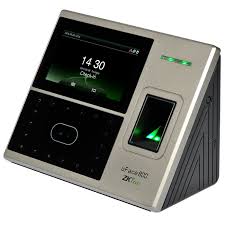
| Office or shop, up to a few hundred staff | ZKTeco uFace 800 | Face and fingerprint, proven | SAR 1,195.43 |
| Busy entrance, touchless | ZKTeco SpeedFace M4 | Fast face recognition with anti-spoofing | SAR 1,593.90 |
| Face, fingerprint and card | ZKTeco MB2000 | Three ways to clock in | SAR 569.25 |
| Sites and field teams | ZKTeco Horus H1 | Portable handheld attendance | SAR 3,984.75 |
Moving from paper or a punch clock? Read switching from a punch clock to biometric attendance.
Biometric data and the PDPL
Biometric data that identifies a person is classed as sensitive data under Saudi Arabia's Personal Data Protection Law, in force since September 2023 and overseen by SDAIA. Practical steps:
- Tell staff in writing what is collected, why, and how long it is kept.
- Store templates on the terminals and server only; do not export them to spreadsheets.
- Limit admin access, and delete a leaver's biometric data on their last day.
- Offer a card option for anyone who cannot enrol a fingerprint or face.
Month-end checklist
- Review missing punches and approve corrections with a reason.
- Check Ramadan and holiday flags were applied.
- Export the overtime report and have the manager sign it off.
- Send the approved data to payroll.
- Back up the attendance database.
Common setup mistakes
- Forgetting to switch on the Ramadan schedule, so staff appear to leave early all month.
- Not entering Eid and national holidays, so hours worked on them are not flagged as overtime.
- Terminals with unsynchronised clocks, so times differ between branches.
Get set up correctly
Count Express supplies and configures attendance terminals and software across Saudi Arabia from sales and distribution centres in Riyadh, Jeddah and Al Khobar. Tell us your shifts on WhatsApp and we will help set the rules, or browse time attendance devices.
Not legal advice. Check current regulations and your contracts with a qualified adviser. Prices include 15% VAT and may change.
Leave a Comment