

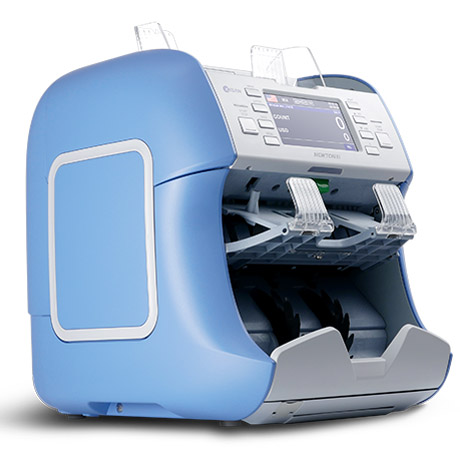
Quick answer: Serial number recording means the counter reads the printed serial number on each banknote with OCR (optical character recognition) while it counts, and saves a list you can export. Tellers, exchange offices and any business taking large cash payments use it to trace a counterfeit back to the transaction it came from, settle "I gave you a 500" disputes, and keep a record of large payouts. Among the machines Count Express sells, the Fin-7900, Kisan Newton3-V and Kisan K2 read serial numbers; some bank sorters offer it as an option.
What the machine actually records
As each note passes the image sensors, the counter photographs it, reads the serial number and stores it with the denomination, the time and the batch. Depending on the model and software, you can then:
- see the list on the screen at the end of the batch,
- print it on a small receipt printer,
- export it to a PC, usually as a spreadsheet you can open in Excel,
- search later for one serial number to see when and in which batch it was counted.
Reading is done by OCR, so very dirty, written-on or damaged notes may come out with a character missing. Good machines flag these instead of guessing.
Why tellers and cash desks need it
1. Tracing a counterfeit
If a fake note is found later, at the bank or in a cash centre, a serial number list tells you which deposit or payment it came in with. Without one, the loss simply lands on whoever counted last.
2. Settling disputes at the counter
"I handed you five 500s, not four." With a saved list showing every note in that transaction, the conversation is short and polite. This matters most for exchange offices, car showrooms, gold shops and property payments, where single transactions are large.
3. Recording large payouts
When a business pays out a large sum in cash, such as salaries, a refund or a supplier payment, a list of the notes paid is an extra record for both sides.
4. Internal audit and shortage checks
When a drawer or a vault count is short, a serial list for each handover shows exactly which notes went where. It turns a guessing game into a check.
5. Marked notes
Some businesses keep a small set of recorded notes in the drawer as a security measure. A machine that logs serials makes this easy to manage.
An example: a cash payment at a car showroom
A customer pays SAR 85,000 in cash for a car. The sales desk runs the bundle through a counter with serial reading. In under two minutes they have the total, the breakdown (for example 160 notes of 500 and 50 notes of 100), and a saved list of all 210 serial numbers, tagged with the date, time and the salesperson's batch. The list is exported and attached to the sale file.
A week later the bank reports one suspect 500 note in that deposit. The showroom searches the serial number, finds it in that customer's batch, and has a clear record to discuss with the customer and the bank. Without the list, the showroom would simply absorb the loss.
Limits to know about
- Serial reading does not prove a note is genuine; it records it. Detection still comes from UV, MG, IR and image checks.
- Notes with ink, stamps or heavy wear across the serial may not read fully.
- A list is only useful if someone files it. Agree where exports are saved before the machine arrives.
Who needs it and who does not
| Business | Serial recording? | Why |
|---|---|---|
| Bank teller, cash centre | Yes | Counterfeit tracing, audit trail |
| Exchange office | Yes | Large mixed-currency transactions, disputes |
| Car showroom, real estate office | Usually | Large one-off cash payments |
| Gold shop | Usually | High-value sales, disputes |
| Supermarket cash office | Optional | Useful for audits and bank deposits |
| Café, pharmacy, small shop | Rarely | Small notes and amounts; a value counter is enough |
Which machines do it
| Machine | Type | Serial numbers | Price incl. VAT |
|---|---|---|---|
| Fin-7900 | Mixed value counter, dual CIS | Reads every note | SAR 6,489.45 |
| Kisan K2 | Two-pocket value counter, 10 currencies | Reads serial numbers | SAR 6,603.30 |
| Kisan Newton3-V | Heavy-duty 1+1 pocket value counter | OCR at up to 1,200 notes a minute | SAR 9,108.00 |
| Kisan Newton 3F | Fitness sorter | Optional, with Kisan software | SAR 9,108.00 |
| Glory GFS-220F | Value counter and sorter | Optional for EUR and USD | SAR 13,662.00 |
If you count Saudi riyals and need every serial recorded, start with the Fin-7900, the K2 or the Newton3-V, and ask us to show the export on your own notes. For a branch that mostly needs sorting by condition, see fitness sorting explained.
What to check before you buy
- Read rate on your notes: run a bundle of worn riyals and see how many serials come out complete.
- Speed with serial reading on: some machines slow down when OCR is active.
- Export format: can your finance team open the file without special software?
- Storage: how many records does the machine keep, and how do you clear them?
- Currencies: if you take dollars or euros, check serial reading works for them as well as riyals.
- Privacy and access: who in the branch can see and delete the logs?
Our guide to 6 tests to do before buying a money counter covers the rest of a showroom check.
Setting it up in a branch
- Agree when serial recording is used: every transaction, or only above a set amount.
- Name files by date, teller and batch so they are easy to find.
- Back the files up weekly to a secure PC or server.
- Decide how long you keep them, in line with your own audit policy.
Talk to us
Count Express supplies bank and exchange office counters across Saudi Arabia from sales and distribution centres in Riyadh, Jeddah and Al Khobar. Ask us for a serial number demo on WhatsApp or browse all money counting machines.
Prices include 15% VAT and may change. Features depend on model and software version; confirm with us before ordering.
Leave a Comment