

Quick answer: A fire safe rated for paper is designed to keep its inside below about 170°C, the point where paper starts to char. USB drives, hard disks, memory cards and the plastic and chip in passports and ID cards can be damaged at far lower temperatures, around 50°C to 70°C, especially with the steam that fire safes release when they heat up. So a safe that protects your title deeds can still cook your backups. For digital media you need a data rating, or a data-rated insert inside your safe, plus an off-site copy.
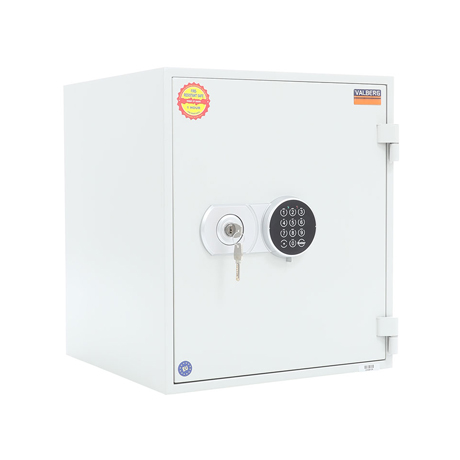
How fire safes actually work
Most fire safes have walls filled with an insulating material that holds water. When the outside heats up, that water turns to steam and carries heat away, keeping the inside cool for a set time. It is a clever design, but it means the inside of a fire safe gets hot and humid during a fire. Paper copes with that. Electronics and plastics often do not.
Paper ratings vs data ratings
| Rating | Made for | Inside limit during the test |
|---|---|---|
| EN 15659 LFS 30P / LFS 60P | Paper | About 170°C, for 30 or 60 minutes |
| EN 1047-1 S 60 P / S 120 P | Paper | About 170°C, for 60 or 120 minutes |
| UL 72 Class 350 | Paper | 177°C (350°F) |
| UL 72 Class 150 | Film, tapes, photos | 66°C (150°F), limited humidity |
| UL 72 Class 125 | Data media | 52°C (125°F), 80% humidity |
| EN 1047-1 S 60 DIS / S 120 DIS | Data media | 50°C, 85% humidity |
The letter at the end tells you most of the story: P means paper, DIS means data. A "60-minute fire safe" with a P rating is a paper safe.
What can be damaged below paper temperatures
- USB flash drives and memory cards: plastic housings warp and soldered parts can fail; heat and humidity together are the main risk.
- External hard drives: heat and moisture inside the drive can make the data unreadable.
- Passports and ID cards: modern passports and national ID cards include plastic layers and an electronic chip. They can deform well before paper chars.
- Photos and film: emulsions soften and stick together.
- Watches with batteries, car keys with chips, phones: electronics again.
Cash, title deeds, contracts, certificates and cheque books are paper and are well served by a paper rating.
Four ways to protect digital media
1. A data-rated safe
The cleanest answer if you hold a lot of media, such as a business keeping server backups on site. These are specialist units and cost more per litre than paper safes. Ask us if you need one sourced.
2. A data insert inside a paper-rated safe
A small, sealed, data-rated media box placed inside a good fire safe adds a second layer of insulation and keeps steam away from the media. For most homes and small offices this is the practical choice: one safe for papers and gold, one small box inside it for drives and passports.
3. Sealed bags as a minimum
If you cannot add an insert, at least keep drives in sealed moisture-proof bags inside the safe. It does not create a data rating, but it reduces the steam problem.
4. An off-site copy
No safe replaces a second copy somewhere else. Keep one backup in the cloud or at another branch, and treat the one in the safe as the quick-to-reach copy.
Which Count Express safes fit the paper side
| Need | Safe | Fire rating | Price incl. VAT |
|---|---|---|---|
| Home documents and gold | Countexpress Safe 85T | Fire-resistant, key and digital lock | SAR 1,980.99 |
| Office papers, compact | Valberg FRS 51 EL+KL | LFS 60P | SAR 1,682.70 |
| Office papers, larger | Valberg FRS 120 EL+KL | LFS 60P | SAR 6,831.00 |
| Files in drawers | Valberg FC 4E-KK | LFS 60P | SAR 5,920.20 |
| Fire and burglary together | Valberg FSB 1993 | LFS 60P, burglary S2 | SAR 18,216.00 |
Pair any of these with a data insert for drives and passports. For the difference between fire and burglary protection, see fire safe vs burglary safe.
Where to put the safe
- Away from the kitchen and the main electrical board, the two most common starting points of house fires.
- On the ground floor where possible: a safe that falls through a burning floor faces a longer, harder fire.
- Not in direct sun against an outside wall, where summer heat in Riyadh or Jeddah keeps the inside warm all day. That is bad for drives even without a fire.
A quick checklist
- List what you keep: paper, gold, cash, drives, passports.
- Check the rating letter on the safe: P or DIS.
- If you hold any electronics, add a data insert or a data-rated safe.
- Keep a second copy of important files off site.
- Bolt the safe down: fire safes are also carried off by burglars. See anchoring a safe.
Quick questions
Can I keep my laptop in a fire safe? You can, but treat it like a hard disk: the paper rating will not protect it in a real fire. Back it up first.
Is a heavier safe better in a fire? Not necessarily. Fire protection comes from the insulation and the tested rating, not from weight. A heavy burglary safe with no fire rating can heat up quickly.
Ask us
Count Express supplies fire-resistant safes and file cabinets across Saudi Arabia, with sales and distribution centres in Riyadh, Jeddah and Al Khobar. Tell us what you need to store, including any drives or passports, and we will suggest a safe and a way to protect the media inside it. Message us on WhatsApp or browse fireproof file cabinets and safes.
Ratings and temperatures are summaries of the published test standards; check the certificate of the specific product. Prices include 15% VAT and may change.
Leave a Comment